Frequently Asked Questions
What are the requirements to get Motiva Implants®
- Breast augmentation for women of at least 18 years of age, including previous augmentation to increase the breast size and revision surgery to correct or improve the result of a previous breast augmentation surgery
- Breast reconstruction, including previous reconstruction to replace breast tissue that has been removed due to cancer or trauma, or that has failed to develop properly due to a severe breast anomaly, as well as revision surgery to correct or improve the results of a previous breast reconstruction surgery
Who should NOT get breast implants?
Breast implant surgery should not be performed in women due to the following conditions:
- Active infections anywhere in their body
- Existing carcinoma of the breast (without mastectomy)
- Advanced fibrocystic disease considered premalignant (without accompanying subcutaneous mastectomy)
- Any disease clinically known to impact wound-healing ability
- Tissue characteristics clinically incompatible with mammoplasty
- Any condition – or treatment – determined by the surgeon to constitute an unjustifiable surgical risk and women who are currently pregnant or nursing
What complications might occur with breast implants?
Breast implant surgery, which is often performed using general anesthesia, is associated with the same risks as other invasive surgical procedures. Complications vary in accordance to the patient. After breast implant surgery, patients may experience the following symptoms over the first few weeks:
- Swelling
- Hardness
- Discomfort
- Itching
- Bruising
- Pain
Additional potential adverse events that may occur with silicone gel-filled breast implant surgery also include:
- Capsular contracture
- Rupture
- Alterations in nipple and breast sensation
- Infection
- Hematoma/Seroma
- Delayed wound healing
- Implant extrusion
- Necrosis
- Granuloma
- Breast tissue atrophy / Chest wall deformity
- Lymphadenopathy
- Gel diffusion
- Gel fracture
- Anaplastic large cell lymphoma (ALCL)
If you are unfamiliar with the previously mentioned terminology and would like to learn more please contact your doctor and / or surgeon. For any additional information please refer to: https://motivaimplants.com
After breast augmentation surgery, how long does the recovery process take?
Is the microtransponder (Qid™) MRI safe? Does it interfere with the MRI images?
Yes, the microtransponder (Qid™) is MRI safe. The device is MRI conditional meaning that it has demonstrated to pose no known hazards in a specified MRI environment with specified conditions of use.
This microtransponder may create an imaging void during a breast implant MRI (known as an artifact effect) that can block visualization of a small area of minor breast tissue near the Qid™. In selected cases, alternative imaging techniques such as ultrasounds, tomosynthesis, digital compression mammogrammy, subtraction contrast mammography and scintimammography can be used to better visualize the region affected by the implant Qid™.
Can breast implants interfere with mammographies?
Can I breastfeed with breast implants?
How long do Motiva Implants® last?
Which Motiva Implants® will give me a round look?
The Motiva Implants that give a round aesthetic appearance are the Motiva Implants® Round with ProgressiveGel PLUS, which provides the highest projection and a complete filling of the upper pole.
It is however important to mention that the desired results for each patient should be evaluated individually by the surgeon.
Which Motiva Implants® gives a more natural appearance?
Why should I choose a Silk or Velvet surface for my implants?
Motiva Implants® are divided into three categories: Round, Ergonomix and Anatomical. What exactly is the difference between them?
Round implants provide a higher top and a more full-bodied appearance. They are the most common implants and are used in almost 80 percent of all breast augmentation surgeries.
Anatomical implants are often called tear-drop-shaped because they are designed to simulate the shape of a natural breast. While the result with an anatomical implant is natural looking, the predefined shape means the implant lacks natural movement and doesn’t shift with the body’s movements. For example, when a patient with anatomical implants moves from lying down to a standing position there is a noticeable lack of breast movement. This is because the implant retains the same shape wether the patient is prone, supine or upright.
Motiva’s Ergonomix® implants avoids this drawback by using a unique gel, which is very soft, allowing the implant to follow a women’s natural movement, holding a round shape when lying down and assuming a teardrop shape when standing. This gives a very natural appearance, both in look and feel.
What is the difference between Mini/Demi/Full/Corse?
What is the Q Inside Safety Technology™ (Qid™)?
The Q Inside Safety Technology is the world’s first FDA approved transponder for use in humans cleared in 2004 and the only one with CE-Mark when used in a breast implant. The microtransponder is a device which is placed in the breast implant filler material. Motiva Implants® with Qid™ contains a transponder that provides electronic serial number data through an external reader for traceability and quality assurance purposes.
This microtransponder has been separately reviewed and cleared for marketing by the U.S. Food and Drug Administration for use as an implantable microchip that is inserted into the subcutaneous tissue of a patient to provide the patient an electronic serial number that may be used to access a database containing the patient’s identity and health information.
Can you recommend a clinic/surgeon that uses Motiva Implants® in my country?
Are Motiva Implants® FDA approved?
Where can I find more information about your products?
Frequently Asked Questions
Why are Motiva Implants® available with RFID technology?
Does the microtransponder require any special care such as charging,replacement or additional clinical procedures?
Are There Any Safety Concerns for Patients With Motiva Implants® with Q Inside Safety Technology?
Can Q Inside Safety Technology™ affect MRI evaluation for a potential implant rupture?
What specifically causes artifacts?
- Underlying physics of the energy-tissue interaction
- Data acquisition errors (e.g., patient movement during the test)
- Poor reconstructive algorithms (unable to properly represent the anatomy)
- Presence of metallic objects (orthopedic hardware, vascular ports, pacemakers).
What Information Needs to Be Provided to the Radiologist Prior to an MRI of Motiva Implants® with Q Inside Safety Technology™?
Are There Alternative or Additional Imaging Modalities That Will Improve Visualization of the Artifact-Affected Area?
- Breast ultrasound.
- Digital tomosynthesis.
- Automated ultrasound.
- Scintimammography.
- Dual energy contrast subtraction digital mammography.
- Dual-energy enhanced mammography.
Other Than Improved Imaging Visualization, Are There Any Other Benefits to Adding a Second Imaging Modality?
What extended warranty programs are available for Motiva Implants® with Q Inside Safety Technology™?
5Y Motiva Program™ : A 5 year extended warranty program is also available for Motiva Implants® with Q Inside Safety Technology™ registered in the Motiva website or Motiva app, only when a non-refundable fee of $200 has been paid to enroll the patient in the program. Patients must also register their Motiva Implants® with Q Inside Safety Technology™ during the first 90 days after the initial breast surgery. Patients enrolled in the 5Y Motiva Program ™, in addition to the replacement product, may also receive financial assistance for each affected implanta applicable to the cost of the revision surgery in the case of a warranty claim for rupture or capsular contracture Baker grades III or IV, when complying to this terms, conditions and claim procedures. I also includes financial assistance for imaging testsb.
a.
- £2500 / Euro Zone
- €2500 / U.K.
- $2500 / Rest of the world
b.
- £500 / Euro Zone
- €500 / U.K.
- $500 / Rest of the world
Frequently Asked Questions
How can I register my Motiva Implants®?
- Open the MotivaImagine App and go to “Register your Implants” or open the MotivaImagine® website and sign up with either Facebook, Google or email address.
- Fill your Personal Information as requested.
- Read the terms and conditions by clicking on “I agree with Terms and Conditions”.
- Agree with terms and conditions by clicking “Agree” at the end of the displayed text.
- Complete the Medical Information as requested and click “Next”.
- Complete the Implants Information.
-
Select your registration method and complete as requested.
- Option A: Serial Number (SN).
- Option B: Electronic Serial Number (ESN).
- Click “Submit” to the registration of your implant(s).
- You will receive a confirmation e-mail indicating that your implant(s) have been succesfully registered.
I have problems registering my implants, what should I do?
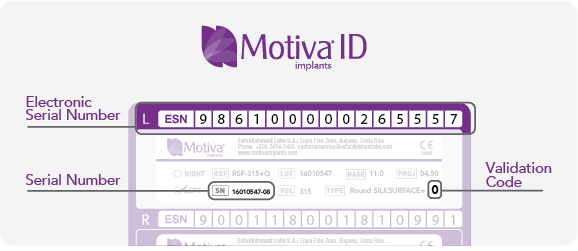
What is the SN / ESN?
Frequently Asked Questions
Are all Motiva Implants® are covered for the lifetime of the device?
How can I extend the coverage of my Motiva Implants®?
To extend the coverage of your Motiva Implants® silicome breast implants; Motiva offers an Extended Warranty Program that applies to qualifying Motiva Implants® silicone breast implants, through an additional fee to be covered by or on behalf of the patient during de first 90 days after the initial breast surgery as specified below:
- First Year Free Coverage. For first year coverage, patients must register their Motiva Implants® silicone breast implants through our website or through the Motiva App within the first 90 days after the initial breast surgery. Patients with Qualified Q inside implants during this first year since implantation in addition to product replacement, in case of rupture or capsular contracture Baker grades III and IV cases, may also receive financial assistance per affected implanta applicable to the cost of the revision surgery when complying with the terms, conditions and claim procedures available in our site and app.
- 2Y Extended Warranty Program. The Motiva 2 year Extended Warranty Program applies only to the qualified SilkSurface® Plus without Q inside and Ergonomix® implants without Q inside registered in the Motiva website and Motiva app when a non-refundable feed has been applied to enroll the patient in the program. Patients must register the implanted devices during the first 90 days after the initial breast surgery. For all registered products with our 2Y Motiva Program™, in addition to the replacement product patient may also receive financial assistance per affected implantb applicable to the cost of the revision surgery for each impacted implant in the case of a warranty claim for rupture or capsular contracture Baker grades III and IV .When complying to the terms, conditions and claim procedures available in Motiva Site and App.
- 5Y Extended Warranty Program. The Motiva 5 year Extended Warranty Program applies only to the qualified SilkSurface® Plus with Q inside and Ergonomix® implants with Q inside registered in the Motiva website and Motiva app when a non-refundable feec has been applied to enroll the patient in the program. Patients must register the implanted devices during the first 90 days after the initial breast surgery. For Motiva Implants® with Q Inside Safety Technology™, with our 5Y Motiva Program™, in addition to the replacement product customer may also receive financial assistance per impacted implant a applicable to the cost of the revision surgery in the case of a warranty claim for rupture or capsular contracture Baker grades III and IV. When complying to the terms, conditions and claim procedures available in the Motiva Site and App.
a.
- £2500 / Euro Zone
- €2500 / U.K.
- $2500 / Rest of the world
b.
- £1000 / Euro Zone
- €1000 / U.K.
- $1000 / Rest of the world
c.
- £200 / Euro Zone
- €200 / U.K.
- $200 / Rest of the world
d.
- £100 / Euro Zone
- €100 / U.K.
- $100 / Rest of the world
Do all the Motiva Implants® qualify for the extended 2 and 5 years warranty?
Qualified Motiva breast implant for the 2Y Extended Warranty are as follows:
- Round, SilkSurface® Plus™ without Qid™
- Round, VelvetSurface Plus without Qid™
- Round, Ergonomix without Qid™
Qualified Motiva breast implant for Free First Year and 5Y Extended Warranty are as follows
- Round, SilkSurface® Plus™ with Qid™
- Round, VelvetSurface Plus with Qid™
- Round, Ergonomix with Qid™
In what cases does the extended warranty not apply?
- Removal of intact implants for capsular contracture, Baker Grade I or Baker Grade II.
- Removal of intact implants for size alteration.
- Removal of intact implants due to wrinkling or rippling.
- Loss of shell integrity caused by or during re-operative procedures.
- Loss of shell integrity resulting from open capsulotomy or closed compression capsulotomy procedures.
- Loss of shell integrity resulting from sharp instrument damage.
Establishment Labs may exclude from the applicable warranty program patients with previous history of capsular contracture Baker grades III and IV.